
Why Your Work Follows You Home
And what to do about it.

There’s a specific kind of tired that doesn’t go away when you close your laptop.
It follows you to dinner. It’s still there when you’re trying to sleep. It’s why you reached for your phone in the middle of a conversation that deserved your full attention. It’s the reason your evenings don’t fully belong to you.
The low hum of open loops: commitments half-made, threads you meant to pick up, the thing from last week’s meeting you haven’t let yourself forget.
At some point, something slipped.
Maybe it was small. A reply you forgot to send, a follow-up that came a few days too late. Embarrassing for a moment, but recoverable.
Or maybe it was bigger. The kind of fuck-up you still think about.
What would have happened if you hadn’t let it slip?
What opportunities did someone else pick up instead?
Meanwhile, someone with the same workload was juggling fifteen of those threads without dropping one.
You’ve seen this person.
The one people lean on because they know they won’t drop the ball.
Walks into every meeting with what feels like an abnormal memory.
Knows the thread from three conversations ago.
Never scrambles.
The person who makes you wonder if the Red Sea just parts for them. While the rest of us are fighting desperately to stay above water.
The one whose work stops when they leave work.
Who is actually present at dinner.
Whose evenings belong to them.
That’s who got those opportunities you missed out on.
Not more talented than you. Not working harder.
Just a better system.
And the frustrating part is you’ve tried to build one.
Everyone has some version of a system.
It works well enough when things are manageable. But as soon as life piles on, the same system that was holding you starts holding you back. A burden you carry out of habit more than hope.
Every tool that was supposed to fix that made the same promise: if you just captured it properly, nothing would fall through.
It still fell through.
Not because the tools were bad. Because every one of them asked you to adapt to it. None of them could keep up when the workload hit.
Here’s why: our brains were never built to hold open loops. They were built to think, to connect, to create. Not to act as a filing cabinet for every commitment made in every meeting ever attended. Every unresolved thread you’re carrying is taking up space that was supposed to go somewhere else.
The problem was never your discipline. It was that you were asking your brain to do something it was never designed for.
For the first time, the system adapts to you. Not the other way around.
What makes that possible is thinking in projects.
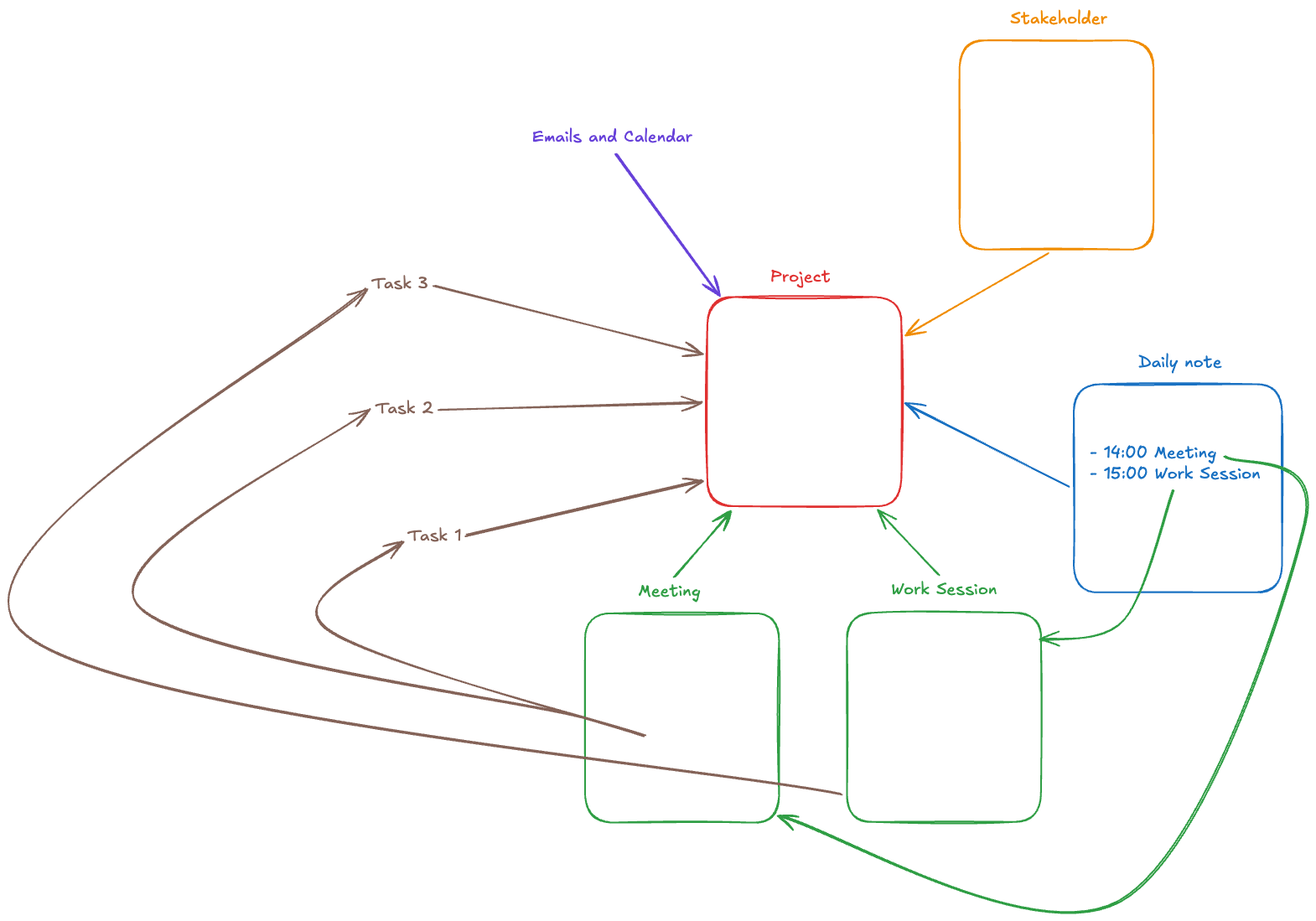
Every project gets a home: one page where everything connects back to it. Meeting notes, work sessions, tasks, decisions. Not scattered across three apps and a notebook. One place.
I had a call last week with a client I hadn’t spoken to in eight weeks. I typed two lines to Claude Code: “Create a meeting with Theo at 2pm tomorrow. Give me context.” Thirty seconds later the meeting was on tomorrow’s daily note, linked to the project, linked to Theo. Inside it: the summary from our last session, the full email chain, and every open item still outstanding. I walked in knowing exactly where we’d left off and what to prep.
That’s Obsidian as the structure, Claude Code as the assistant that handles the administration. The logging, the linking, the filing. All of it handled without you touching it.
This results in you having more time to think about the important things instead of spending an hour or two sifting through notes like a depressed European in the winter looking through their medicine cabinet for vitamin D pills.
The evenings come back. The dinners belong to you again. You become the person who walks into every meeting knowing exactly where things stand. Not because you have a better memory, but because you stopped asking your brain to do a job it was never built for.
That’s the system. The one that makes you the person who never scrambles.
Want to build it out?
Lifestack-OS (free webinar happening 2026-05-09)
Much love,
Dee
Construct by DeeWebsite | YouTube | X / Twitter | Lifestack-OS | Newsletter